Covid - the Politics of Fear and the Power of Science (9781684426874) by Siegel Marc
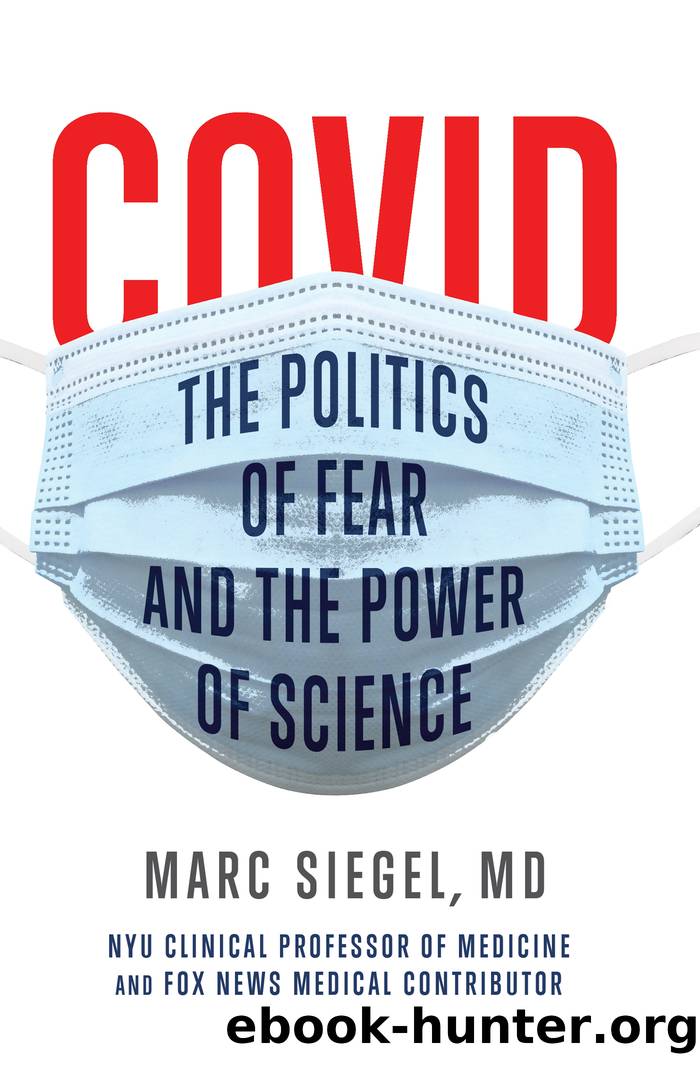
Author:Siegel, Marc
Language: eng
Format: epub
Publisher: Lightning Source Inc
Published: 2020-10-14T16:00:00+00:00
SWINE FLUâTHE LAST PANDEMIC
APRIL 2009: THE WORRIED BUS DRIVER
My sonâs school bus driver had told me several months earlier that he was having problems sleeping at night. I had offered advice on developing a sleep ritual, and he soon began looking more relaxed. But when the swine flu scare first hit in late April, he was again appearing fatigued. He said he was worried about the risks that going to school might pose to students. I was worried too, not about swine flu, but about his driving my son and other children in his sleepless condition.
I told him that the flu appeared to be mild and that there were only a few cases in the city. The danger was minimal, I said. He didnât seem reassuredâand he wasnât the only one. As the new virus continued to spread, I was having difficulty helping my patients, friends, and relatives put the fear of this new flu strain in perspective.
With previous scares, such as those connected to bird flu, anthrax contamination, mad cow disease, and the West Nile virus, Iâd been able to point out that the pathogen wasnât spreading person to person and was therefore of limited concern. But this wasnât the case with the new H1N1 flu.
I tried my best to explain the science of flu to the bus driver as well as to my patients. A flu virus is a package of genetic material (called RNA) inside an envelope. âHâ refers to hemagglutinin, the protein on the envelope that enables the flu to attach to your cell and inject itself inside. The âNâ is neuraminidase, the protein that helps a flu virus break off from your cell and move on to a new cell. The new strain appeared to be the result of what is known as a âtriple-reassortantâ swine influenza strain (with mixed genes from human, swine, and bird flu viruses) that had been confined mainly to pigs (pigs are a mixing vessel for flu) until it combined again, with a Eurasian swine flu strain. This new strainâthough still mild in severityâbegan passing easily from human to human, causing the March 2009 outbreak in Mexico and the United States.
I also explained to my patients that though this virus was transmitted fairly easily, like many influenzas it appeared to lack certain proteins that made other flu viruses more deadly. One of these, known as PB1 2, weakens the immune system by attacking the protective covering of cell mitochondria (motors). All the pandemic flus of the twentieth century made this enzyme, but the new swine flu strain did not, which was good news. Another enzyme the virus lacked (luckily) is responsible for blocking the bodyâs production of interferon, a crucial chemical that helps us keep the flu virus from spreading easily from cell to cell.
An article in the New England Journal of Medicine suggested that many people (those born prior to 1957) might have a partial immunity to this strain because of prior exposure to other related H1 viruses that were circulating at the time.
Download
This site does not store any files on its server. We only index and link to content provided by other sites. Please contact the content providers to delete copyright contents if any and email us, we'll remove relevant links or contents immediately.
| Anthropology | Archaeology |
| Philosophy | Politics & Government |
| Social Sciences | Sociology |
| Women's Studies |
The Secret History by Donna Tartt(19480)
The Social Justice Warrior Handbook by Lisa De Pasquale(12301)
Thirteen Reasons Why by Jay Asher(9135)
This Is How You Lose Her by Junot Diaz(7062)
Weapons of Math Destruction by Cathy O'Neil(6487)
Zero to One by Peter Thiel(5955)
Beartown by Fredrik Backman(5952)
The Myth of the Strong Leader by Archie Brown(5632)
The Fire Next Time by James Baldwin(5596)
How Democracies Die by Steven Levitsky & Daniel Ziblatt(5338)
Promise Me, Dad by Joe Biden(5238)
Stone's Rules by Roger Stone(5196)
A Higher Loyalty: Truth, Lies, and Leadership by James Comey(5092)
100 Deadly Skills by Clint Emerson(5034)
Rise and Kill First by Ronen Bergman(4908)
Secrecy World by Jake Bernstein(4897)
The David Icke Guide to the Global Conspiracy (and how to end it) by David Icke(4856)
The Doomsday Machine by Daniel Ellsberg(4632)
The Farm by Tom Rob Smith(4614)
